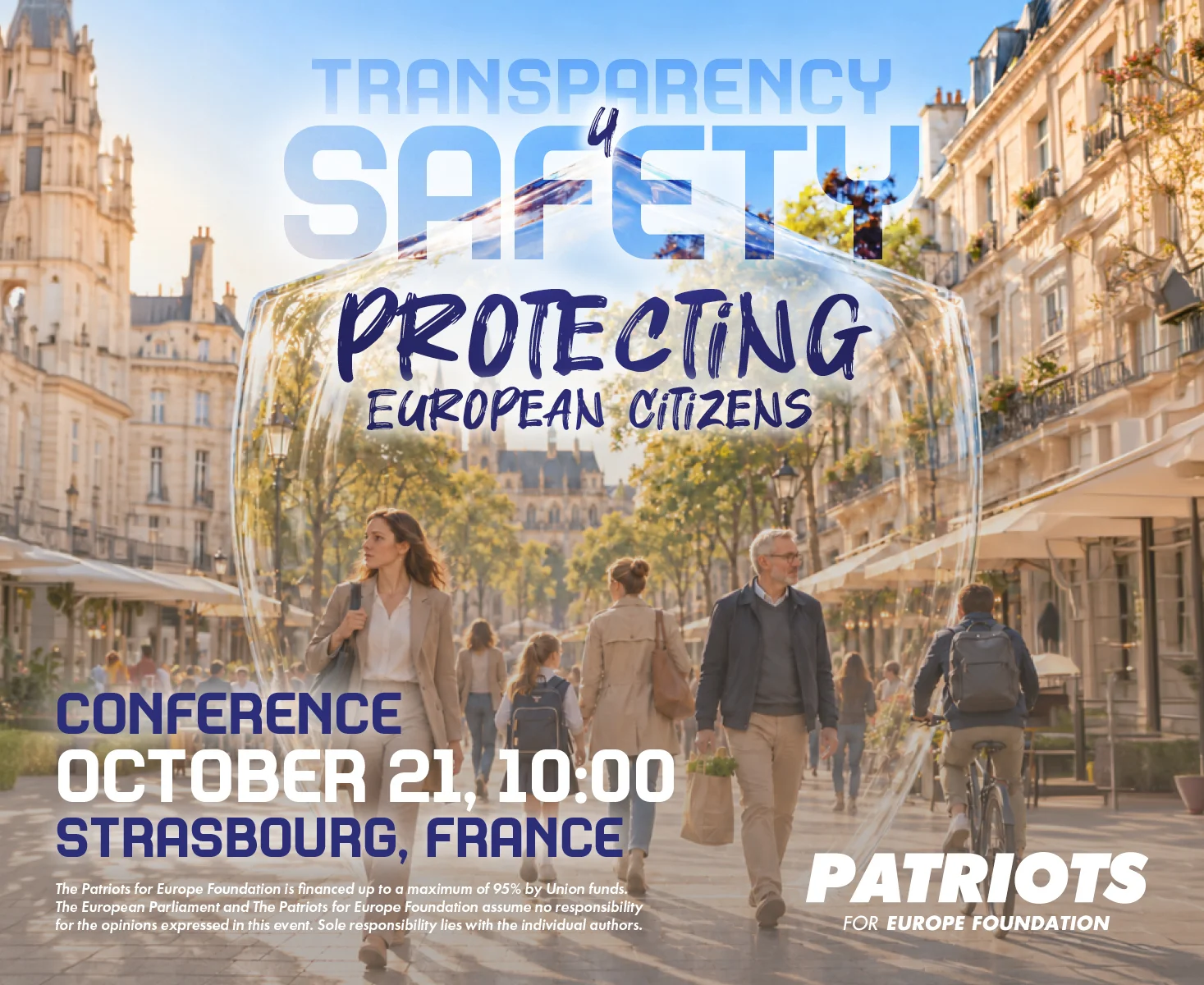

Transparency4Safety - Protecting European Citizens
Conference
21.10.2026
Strasbourg, Sofitel gran Ile - 10:00 AM
Registration required
Summary
Join us in Strasbourg at Sofitel Grande Île for Transparency4Safety, a conference examining transparency, regulation, pharmacovigilance and patient safety in Europe
Transparency4Safety - Protecting European Citizens
Europe stands at a critical crossroads. While citizens place their trust in safe and effective medicines, questions surrounding regulatory transparency, conflicts of interest, access to clinical data, pharmacovigilance and the independence of European regulatory processes continue to generate significant debate.
Across four sessions, participants will consider the evidence from regulatory classification and non-clinical assessment, through pharmaceutical quality and molecular characterisation, to post-authorisation safety data and the performance of European pharmacovigilance.
Bringing together scientists, clinicians, pharmacovigilance specialists and legal experts, the conference is designed for substantive exchange and detailed examination of the evidence.
The Questions Before Us
— Who truly decides which medicines are safe for European citizens: independent national authorities and elected representatives, or an under-scrutinised agency in Amsterdam heavily funded by the industry it regulates?
— How can Member States reclaim meaningful oversight when clinical data remains partially hidden, conflicts of interest persist, and conditional authorisations expand?
— What concrete reforms are needed to guarantee full transparency of trial data, real independence of experts, and timely detection of safety signals?
— How do we ensure that patient safety and democratic accountability are never subordinated to commercial pressure or centralised bureaucratic convenience?
Join us afterward for a cocktail reception!
AGENDA
10:00 Welcome and Opening Remarks
András László, President, Patriots for Europe Foundation; Member of the European Parliament (Fidesz)
10:15 Keynote Address
Gerald Hauser, Member of the European Parliament (FPÖ)
Why European citizens are entitled to see the evidence on which their medicines were authorised.
Online Contribution
Dr. med. vet. Helmut Sterz, toxicology; adequacy and representativeness of the nonclinical safety package (online)
10:30 Panel I – Regulatory and Legal Framework
This panel establishes the legal and regulatory frame for the day. It examines how mRNA and lipid nanoparticle products were classified within European pharmaceutical law, whether that classification was scientifically and legally appropriate to their biological mechanism, and what a possible misqualification would imply for the marketing-authorisation framework and for the expertise engaged in the assessment. The central question is whether the chosen regulatory category determined the level of drug-safety evaluation that was required, and therefore the depth of scrutiny these products actually received.
The session closes with open discussion with the audience.
Speakers:
Dr. iur. Silvia Behrendt, EU pharmaceutical law; marketing-authorisation framework; GHRA
Jun Ueda, PhD, international regulatory perspective; biological mechanism; Asilomar Initiative
11:45 Coffee Break
12:00 Panel II – Scientific Evidence: Product, Toxicology, Manufacturing and Quality
This panel will address the underlying scientific evidence, without legal contributions.
It turns to the medicinal product itself: the biological mechanism and the intracellular fate of modified mRNA; the non-clinical safety package and the adequacy and representativeness of the toxicological test substances; the structure, particle characteristics and formulation of the lipid nanoparticle; the manufacturing process from the material manufactured commercially, to comparability, release specifications and the validation status and limits of the analytical methods on which batch release and regulatory confidence rest. The governing question is whether the material that was tested adequately represented the material that was administered.
Speakers:
Prof. Dr. Andreas Schnepf, inorganic chemistry; product and LNP characterisation; Chemistry OPIR
Maria Gutschi, PharmD, EMA dossier synthesis Residual DNA and SV40
13:15 Lunch and Standing Buffet
14:30 Panel III – Long-Term Biological Safety
The panel sets out the scientific evidence first: what has been measured and by which methods, the limitations of qPCR, the difference between measuring drug substance and measuring the final formulated product, and what independent sequencing has established about plasmid and SV40-derived DNA.
It examines the regulatory dossier and the disclosure history, what was submitted to the authority and when, and what was assessed, before considering the scientific significance of these findings and their possible implications for long-term biological safety.
Speakers:
Maria Gutschi, PharmD, EMA dossier synthesis; Residual DNA and SV40
Dr. med. Michael Mörz, pathology and pathological findings relevant to post-authorisation safety
15:45 Coffee Break
16:00 Panel IV
Pharmacovigilance versus Real-World Evidence
The final panel sets the official pharmacovigilance system against real-world evidence. It examines periodic safety update reports, EudraVigilance and spontaneous reporting, the structural extent of underreporting, and batch-dependent safety observations together with the relationship between product quality and reported adverse-event patterns.
Speakers:
Jonathan Gilthorpe, batch-dependent differences in reported adverse events
Wouter Aukema, PSURs, EudraVigilance and signal detection
Franziska Meyer-Hesselbarth, regulatory action and patient safety
Jun Ueda, PhD, Asilomar, precaution and informed consent
17:10 Closing Remarks
MEP TBC
17:30 Cocktail Reception
Speakers
Gerald Hauser
Member of the European Parliament, FPÖ (Austria)
András László
President, Patriots for Europe Foundation; Member of the European Parliament, Fidesz (Hungary)
Dr. iur. Silvia Behrendt
EU pharmaceutical law; marketing-authorisation framework; GHRA
Jun Ueda, PhD
International regulatory perspective, biological mechanisms and the Asilomar Initiative
Prof. Dr. Klaus Steger
Molecular biology, Process 1/Process 2, comparability and residual DNA
Prof. Dr. Andreas Schnepf
Inorganic chemistry, product and LNP characterisation
Dr. med. vet. Helmut Sterz
Toxicology and the non-clinical safety package
Dr. Franziska Meyer-Hesselbarth
Legal and regulatory perspective, with particular focus on pharmacovigilance and patient safety
Jonathan Gilthorpe, PhD
Real-world safety evidence, batch-dependent safety and product-quality-related adverse-event patterns
Dr. med. Michael Mörz
Pathology and pathological findings relevant to post-authorisation safety
Maria Gutschi, PharmD
Regulatory assessment, CTD and comparability